
Urban Action
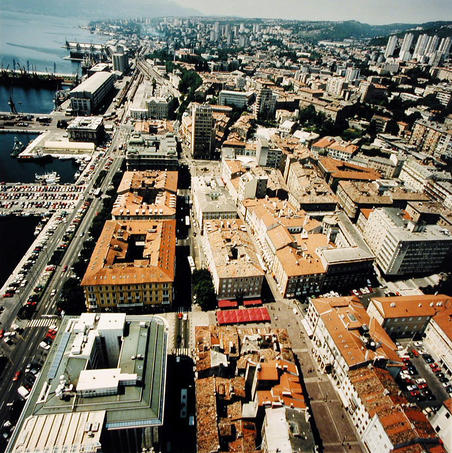
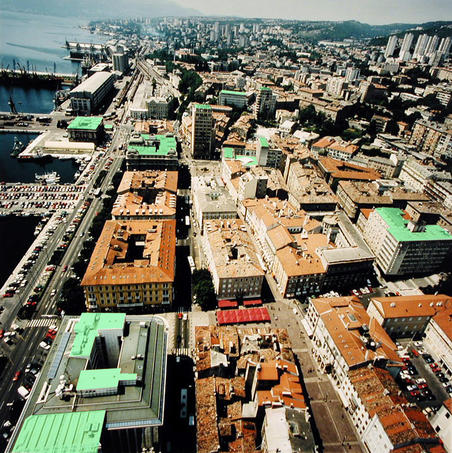
Green Roofs of Rijeka
Due to the formation of urban heat islands, almost every city is periodically affected by episodes of extreme heat. The development of urban heat depends on elements of physical geography such as the lithosphere, hydrosphere and atmosphere, but also on anthropogeographic factors, since the size of a city and the way it is built up significantly contribute to heat accumulation.
The urban centre of Rijeka, Croatia’s largest port city, is, like the centres of similar port cities such as Marseille, Genoa and Trieste, very compactly built and almost without vegetation. Densely arranged buildings and asphalt and concrete street and square surfaces absorb solar radiation throughout the day.
The accumulated heat is released into the urban environment at night. Urban traffic and the increasing use of energy for air conditioning also have an unfavourable effect. Narrow city streets lined with tall buildings direct air flow poorly and prevent the wind from carrying excess heat away.
This proposal points to the possibility of planned implementation of a green network on
the existing flat roofs of the city, which in the long term should contribute to a more
favourable microclimate in Rijeka.
Urban Action
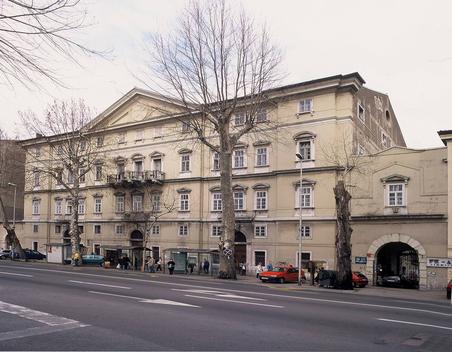
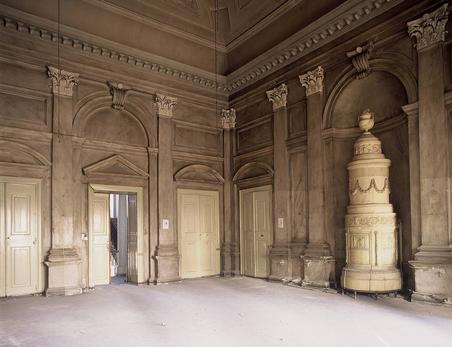
Open Doors Week of Rijeka’s Architectural Heritage
There is a whole sequence of buildings belonging to Rijeka’s architectural heritage which, in the historical stratification of the city and the wider area, possess historical, aesthetic, cultural, scientific or ambient value, and yet citizens and tourists cannot freely visit them.
Most often, such buildings are occupied by commercial, sacred or other functions whose everyday operation would be disturbed by visits from a larger number of people. In other cases, complete neglect and disrepair of heritage buildings is itself the reason why public visits are not allowed.
One example of such a heritage building is the administrative building of the former Sugar Refinery, whose valuable interior is completely hidden from the public eye. Other such buildings include the refectory of the Franciscan monastery, the lapidarium and Leaning Tower of the Church of the Assumption of the Blessed Virgin Mary, the former Munition Factory building, the City Tower, certain parts of the Governor’s Palace and the Fenice Theatre, the Brajda washhouse, and others.
The fundamental intention of this urban action lies in establishing the conditions for unhindered visits to such buildings, at least during a temporary period of one week per year.
The urban action Open Doors Week of Rijeka’s Architectural Heritage was exhibited in Zagreb in 2012 at the 47th Zagreb Salon, the national exhibition of achievements in architecture and urbanism.
Perhaps the main organiser of the proposed urban action could be the Rijeka Tourist Board.
Urban Action
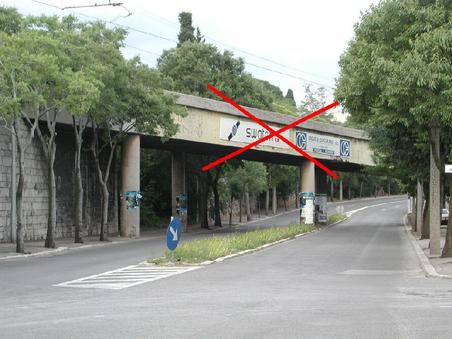
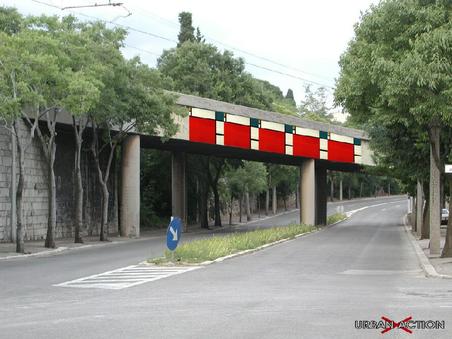
Overpass of the Rijeka – Ljubljana Railway Line
Above Liburnijska Street runs the overpass of the main Rijeka–Pivka–Ljubljana railway line. It is an important transport infrastructure structure. The large, elevated mass of the railway overpass rests on massive concrete columns and dominates the streetscape.
The overpass has been neglected for decades and significantly contributes to the negative impression experienced by every passer-by and traveller entering the city centre from the west.
This urban action proposes using the wide possibilities of artistic interventions that
could significantly enrich the appearance of the currently neglected overpass.
The proposal simulates only one of many possibilities: the implication of a multiplied image by the famous painter P. Mondrian on the concrete structure and railing of the overpass.
Similar artistic solutions, which could be the subject of separate public competitions, would certainly contribute to correcting this neglected urban view. In addition, the installation of valuable artworks in public urban space would also have an educational significance in the field of visual culture.
Urban Action
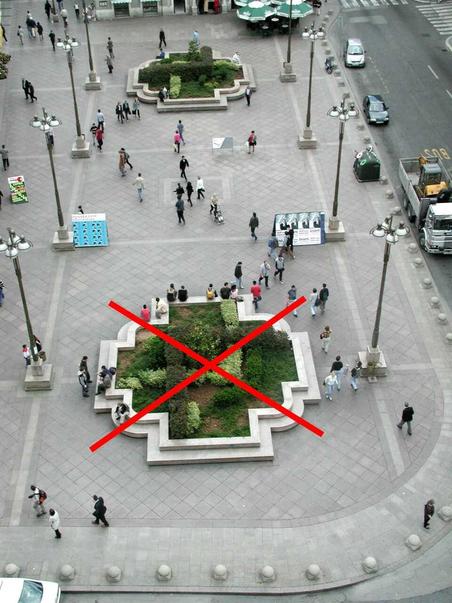
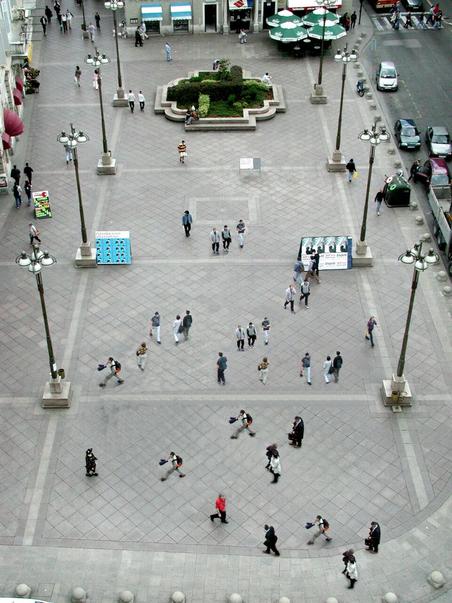
Fountain at Jadranski Square
During the redesign of Jadranski Square in 1992, a major spatial, formal and functional mistake was made. For purely decorative and formalist reasons, two elevated neo-baroque forms were placed on the square: large planters for greenery.
The western planter in particular creates a serious obstruction to the intense diagonal pedestrian flow from Rijeka’s skyscraper toward the Korzo promenade and back. Between the planter and the base of the lighting column, one of the main pedestrian routes of the city centre is forced through a very narrow passage only 2.25 metres wide.
Through this urban action we propose the complete removal of this clumsy spatial barrier.
Urban Action
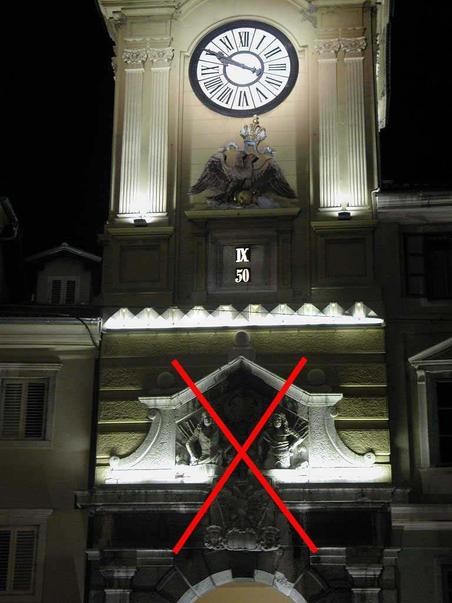
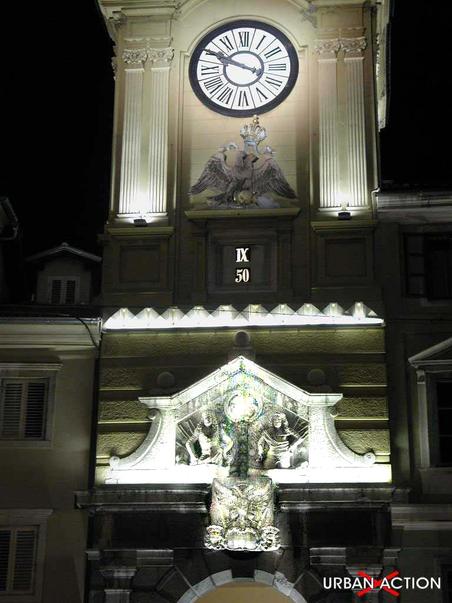
Rijeka City Tower
The long history of Rijeka is inscribed on the face of the City Tower, a building that stands as a true architectural and artistic symbol of the city.
The tower is an imposing structure divided by a string course into three zones: the ground floor with an entrance framed by a stone portal and surmounted by the Habsburg eagle, the first floor with relief busts of Emperor Leopold I and Charles VI, and the second floor with window openings.
The relief busts were created in the period when Charles VI ascended the throne and when Emperor Leopold I issued the diploma granting Rijeka its coat of arms, the double-headed eagle with both heads turned in the same direction. Beneath the coat of arms is the motto “INDEFICIENTER”, meaning inexhaustible.
The busts of Emperor Leopold I and Emperor Charles VI were placed on the City Tower in gratitude after these Habsburg emperors declared Rijeka a free port.
Throughout its long existence, the City Tower has been repeatedly restored and architecturally renewed (1639, after the earthquake of 1750, then in 1800, and in more recent times in 1986, when restoration works on the imperial reliefs were carried out by academic sculptor Z. Kamenar).
The commendable and noble intention of the most recent refurbishment in 2013, when new contemporary lighting was installed to properly emphasize the main architectural forms of this historic structure, nevertheless likely made an inadvertent mistake: the stone busts of the emperors and the old city coat of arms on the first floor remained unlit.
These stone fragments of the tower, which testify to Rijeka’s rich past, must be properly illuminated and highlighted on the façade.
Therefore, this urban action proposes a simple correction of the lighting through a new
lighting design solution.
Urban Action
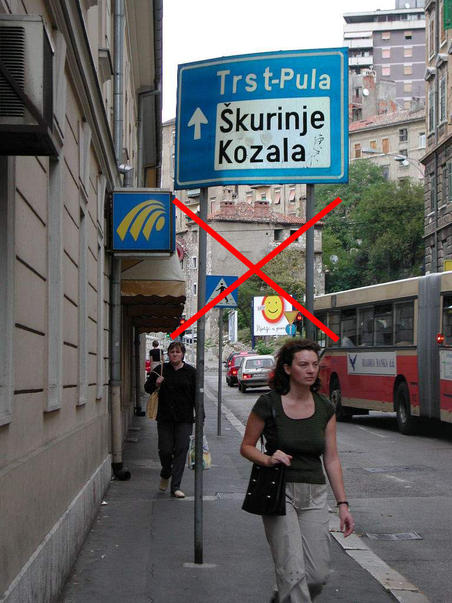
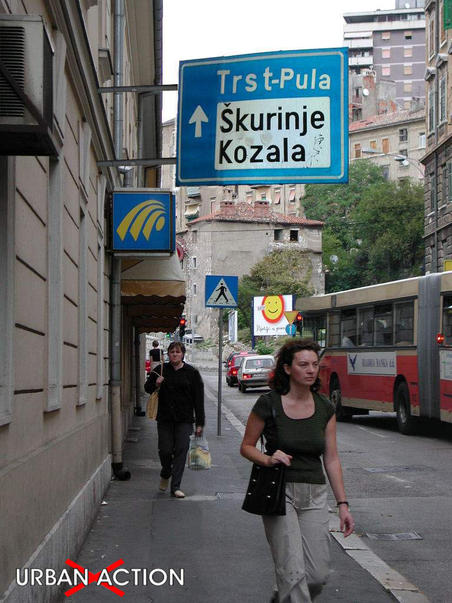
Traffic Sign in Manzoni Street
Urban design is a science, a technique, a legal discipline and an art. Many different disciplines should participate in this activity, and yet a proper and satisfactory urban solution often cannot be achieved without the leading role of the urban planner or architect, because the shaping of space, and therefore urban space, is one of the central goals of their professional formation.
This was not the way many traffic signs in central Rijeka were positioned. They were placed solely to satisfy utilitarian traffic demands and to facilitate vehicle movement.
In the case of the improperly placed bulky traffic sign supported on two steel vertical pipes at the western entrance pavement of Manzoni Street, the traffic engineer or civil utility engineer should have realised that a sign which is useful for directing cars along the roadway must not simultaneously become an urban barrier for pedestrian movement along the pavement.
In fact, the sign could have been elegantly fixed to the building façade using cantilever brackets positioned above the pavement itself.
Through this urban action, we wish to emphasise that professionals in the fields of traffic or civil engineering who intervene in urban space must develop a specifically urban way of understanding city problems and necessarily abandon certain inherited limitations of their discipline.
Urban Action
Vladimir Nazor Park
At the end of the 19th century, Archduke Joseph, brother of the Austro-Hungarian Emperor and King Franz Joseph, bought from the then mayor Ciotta a villa and park near the Governor’s Palace and close to the Lešnjak spring.
In the 19th century, there was great interest across Europe in cultivating exotic plants. In Rijeka, Archduke Joseph, an enthusiastic botanist, made a major contribution to the acclimatisation of exotic vegetation. Through maritime connections, he was able to obtain a wide variety of plants transported by ships from distant seas, and thus created a remarkable botanical garden around his villa, stretching from the Street of the Victims of Fascism to below Belveder.
At the bottom of his estate, the Archduke built a special pump house which drew water from the Lešnjak spring for the park’s pools and for irrigating the entire complex.
After the death of Archduke Joseph, the park was parcelled out, the new Vladimir Nazor Road was built, and only miserable remnants of the once-rich botanical garden remained.
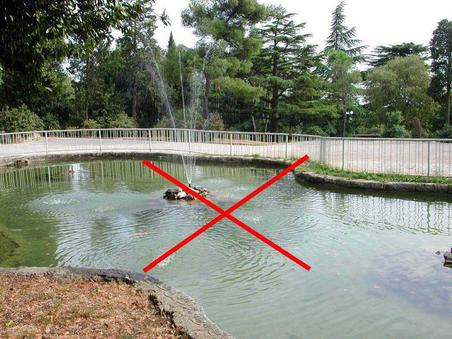
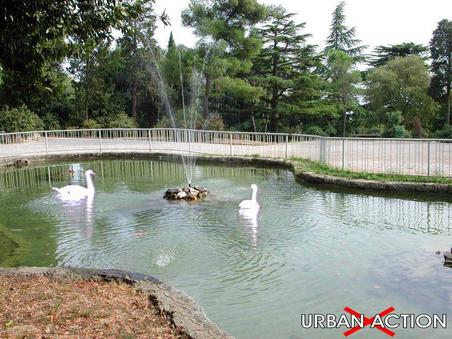
Particularly neglected today is the preserved pool located on the widened elevated part of the park above Vladimir Nazor Street.
Through this urban action we stress the necessity of respecting and maintaining Rijeka’s
park heritage, which is otherwise very modestly represented in relation to the growing
needs of the contemporary city.
We propose the restoration and new arrangement of the pool, where swans, once long-time inhabitants of the park, could again find a home.
Urban Action
Slum in Mihaćeva Draga
The social topography of urban territory is a recognisable feature of pre-industrial cities, whose population was simultaneously divided by class, ethnicity and religion, so that specific social groups and factions occupied certain, often separate and differentiated, urban spaces.
The phenomenon of social topography also appears in modern industrial cities. Everyone knows the social segregation of poor and wealthy residential districts in cities such as London, Paris, Vienna, Genoa, and Zagreb. Class-based and sometimes ethnic zoning is one of the basic characteristics of the developed industrial city and an unavoidable consequence of social relations.
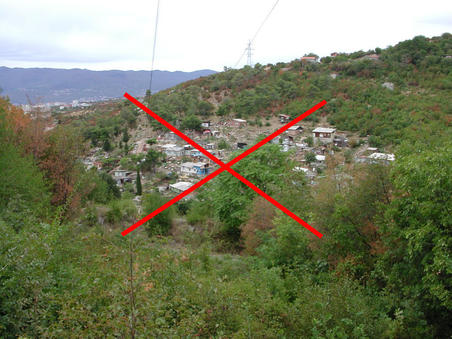
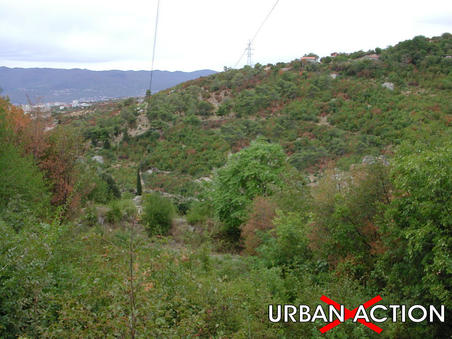
However, within the administrative borders of Rijeka, additional suburban zones of poverty emerged during the city’s development — frightening slums, areas of completely uncontrolled and illegal construction about which only very limited public discussion was ever conducted.
These areas can be precisely located in the outer city districts of Škurinje (Mihaćeva Draga) and Pehlin. Unlike the slums of large European, North American or Latin American cities, Rijeka’s slums never reached a great territorial extent nor became a major political issue, but they still significantly contributed to the city’s social differentiation and left a clear and unpleasant mark on urban space.
The illegal settlement in the hollow of Mihaćeva Draga and Pehlin emerged as a result of massive rural exodus after the Second World War without parallel development of Rijeka’s industrial capacity and housing stock sufficient to absorb it. These spontaneously formed residential spaces became quasi-permanent peripheral settlements inhabited by an extremely poor population without adequate prospects of obtaining utilities and achieving basic sanitary, housing and communal conditions.
They are also sociologically peripheral. The people living there are owners of makeshift huts and wooden shacks covered with sheet metal and roofing felt, but they are not legal owners of the plots themselves. They survive with minimal means and do not participate in the social life of the city. Possessing an illegal location, they are in a weak position when it comes to claiming rights enjoyed by other citizens.
Through this urban action, an urgent solution to this public and spatial problem is proposed.
All urban actions
-
Green Roofs of Rijeka
2015 / Rijeka, city centre -
Open Doors Week of Rijeka’s Architectural Heritage
2012 / Rijeka, city centre -
Overpass of the Rijeka – Ljubljana Railway Line
2001 / Rijeka, Liburnijska Street -
Fountain at Jadranski Square
2001 / Jadranski Square, Rijeka (in front of Erste Bank) -
Rijeka City Tower
2001 / Rijeka, City Tower -
Traffic Sign in Manzoni Street
2001 / Rijeka, Alessandra Manzonija Street -
Vladimir Nazor Park
2001 / Rijeka -
Slum in Mihaćeva Draga
2001 / Rijeka